Ep 21. After Cancer Ends, the Real Work Begins


Ringing the bell doesn't mean the journey is over. It means a different, harder, quieter one is just beginning.
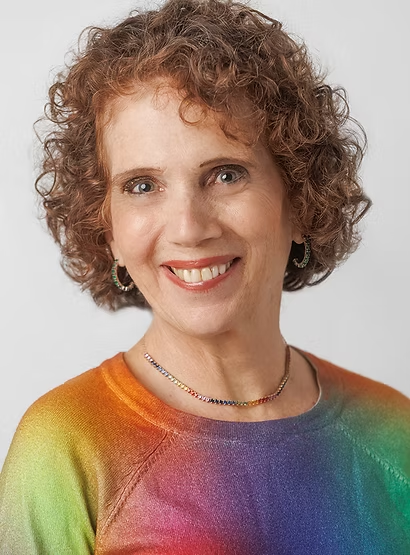
In this episode of Let Me Know If You Need A Podcast, Amy Steinhour and Kristen Beck sit down with Harriet Cabelly, a licensed clinical social worker, speaker, and author of two books, including Light Through Darkness: Miracles Along My Cancer Journey, to talk about what actually happens after treatment ends, and why the support so often disappears exactly when survivors need it most.
Drawing from Viktor Frankl's Man's Search for Meaning, her own Non-Hodgkin's lymphoma diagnosis, and decades of clinical work with people navigating critical life transitions, Harriet unpacks post-traumatic growth, the grief that lives inside illness, and why rebuilding a life after cancer is nothing like resuming the one you had before.
Meet the Expert
Harriet Cabelly is a licensed clinical social worker, speaker, and author who has spent decades helping people navigate grief and major life transitions. Four years ago, she became a patient herself after a Non-Hodgkin's lymphoma diagnosis, giving her a rare view from both sides of the couch. She writes and speaks on post-traumatic growth, resilience, and what it actually takes to rebuild after hardship, work she now applies to her own survivorship as much as to her clients'.
The Big Idea
Most people assume survivorship means returning to the life you had before cancer. Harriet makes the case that this isn't just unrealistic, it's the wrong goal entirely.
That reframe shows up as:
- No such thing as "resuming" life after treatment, only rebuilding it
- Support that reliably disappears right when treatment ends and survival mode wears off
- Post-traumatic growth that gets confused with toxic positivity, when it actually requires holding both grief and joy at once
- A rebuilding process that cannot start until the loss itself has been grieved
The opportunity here is grief before growth: understanding that genuine post-traumatic growth requires sitting in the hard feelings first, not bypassing them with positivity.
Key Takeaways
- "Done" isn't done. Ringing the bell signals the end of treatment, not the end of the emotional work. For Harriet, the hardest part began after.
- Post-traumatic growth is not toxic positivity. It's holding grief, anger, and jealousy in one hand and small moments of joy in the other. Neither cancels the other out.
- Survival mode gets people through treatment, not through recovery. Harriet describes treatment as moving forward with blinders on, just putting one foot in front of the other. The processing happens later, often alone.
- You have to grieve the loss before you can rebuild. The lost expectations, the lost version of your body or your future, have to be acknowledged before new dreams can take their place.
- Having the tools doesn't mean you don't need them. Even as a therapist trained in exactly this work, Harriet still needed the same process she teaches her clients.
Tools, Strategies, or Frameworks Mentioned
- What's Working Well: A single-question daily practice for finding one moment of gratitude without bypassing pain, helping break stuck negative spirals one small thing at a time.
- The Power of "And": Harriet's framework for holding grief and joy simultaneously, helping survivors and supporters resist toxic positivity without abandoning hope.
- Grief First, Vision Second: The two-step process of acknowledging what was lost before building what comes next, so survivors don't skip the emotional work that makes rebuilding real.
Final Thoughts
The most powerful reframe isn't "stay positive and move forward."
It's this:
You can't rebuild a life you haven't grieved.
If someone in your life recently rang the bell, consider this your reminder that the real work, and the real need for support, is often just beginning. And if that's you, you're allowed to grieve what cancer took before you're ready to figure out what comes next.
"There is no such thing as returning or resuming. That doesn't exist. It's rebuilding." — Harriet Cabelly
🎧 Listen to the full episode: https://youtu.be/aPtIapfRMuE